











Dogoos

Live

Know how they feel

Android2026
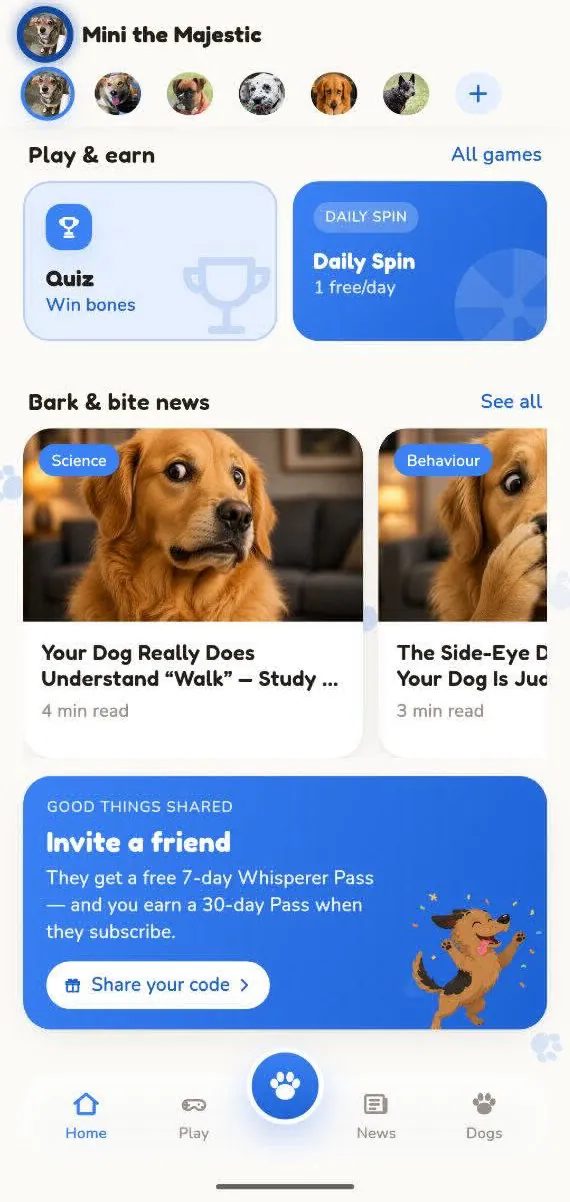
The Dogoos home screen, showing the active dog and a Live Read card

Dogoos reads a dog's affective state from a short video clip — fusing face, body language and vocal tone into a mood, a real confidence score and the observable cues behind it — and refuses to guess when it can't see the dog clearly.

The problem

Fear hides in plain sight

Dogs tell you how they feel constantly — with their ears, their weight, the set of their mouth, the pitch of a whine. The signals are all there. Most of us just never learned to read them, and the quietest ones, the lip-licks and the yawns, slip past almost everyone.

So Dogoos reads the whole dog at once. Face, body language and vocal tone together, the way a great trainer does — not one tail, not one bark, and never a sentence invented on your dog's behalf.

One signal can mislead. Reading several together is how researchers actually measure emotion.

How it works

The pipeline, step by step

A read is one multimodal call, wrapped in a lot of care about what goes into it and what happens when the answer isn't good enough to show.

  1. 01

    Record a short clip

    Five seconds on the free tier, ten or twenty for subscribers. Video and audio together — the vocal track matters as much as the picture, and separating them loses the correlation between them.

    5s / 10s / 20s
  2. 02

    Attach the right dog

    If more than one dog is in frame, the model needs to know which one you mean. The active dog's profile photo is downscaled to 512px and sent ahead of the clip as a visual reference. It loads in parallel with recording, is bounded at six seconds, and falls back to null rather than blocking the read.

    ≤512px reference, 6s bound, best-effort
  3. 03

    Fold in what you already know

    Ten one-tap context tags — just had a treat, said 'walkies', someone came home, just woke up, loud noise — go into the prompt as stated context. Knowing a doorbell just rang changes what an alert posture means.

  4. 04

    One multimodal call — the model is the fusion head

    The research plan in the repo specifies a proper cross-attention fusion head over frozen audio encoders and pose keypoints. This ships the lesson instead of the architecture: a single Gemini call that is asked to score face, body and sound separately and then reconcile them. The clinical design is documented, costed, and deliberately not built yet.

    docs/01-ai-approach.md §7
  5. 05

    Six states, each with a written definition

    Playful, Engaged, Uncertain, Puzzled, Startled, Appeasing. Each carries a behavioural definition in the system prompt rather than a label alone. 'Appeasing' is explicitly framed as a response to your tone — the prompt states outright that dogs do not experience guilt, because the alternative is flattering the owner with a lie.

    6 states
  6. 06

    Real sub-scores, not decoration

    The face, body and sound meters on screen are the model's actual per-modality scores. When the audio is uninformative the sound meter is genuinely low, and the confidence figure reflects that rather than smoothing it away.

  7. 07

    The quality gate — refusing to guess

    Too dark, too blurry, dog occluded, dog not identifiable: the model returns quality: "insufficient" with a reason, and the app shows a 'couldn't read clearly' card. No mood, no confidence, no invented cues. This is the single most important behaviour in the product, and it is the one most apps in this category do not have.

    quality: "insufficient"
  8. 08

    Keep the moment, delete the clip

    One still is kept at 900px as a keepsake. The video itself is deleted from disk as soon as the read completes and is never uploaded to storage.

    ≤900px still, clip deleted

Why it works this way

85%

More accurate with fusion

of published emotion-reading systems improved once they combined signals rather than trusting one · Meta-analysis of 90 systems, ACM Computing Surveys

4 in 10

Couldn't define stress

dog owners, asked about their own dog · Survey of 1,190 owners, Journal of Veterinary Behavior

2.6×

Amused, not concerned

more often, people watching popular dog videos found a frightened dog funny than showed concern · Frontiers in Veterinary Science, 2021

Honest by design

An AI that can say "I can't see your dog."

Most pet apps will happily invent an answer. Dogoos won't. If the clip is too dark, too far away, or your dog just isn't in it, the read says so — no confidence theatre, no made-up moods. When you do get a verdict, it's one the AI actually believes.

  • Real confidence scores — never simulated
  • Low-quality clips are declined, not guessed at
  • Clips are sent for analysis, then deleted — never stored
  • Insight and fun — never veterinary advice

Hmm — where's the dog?

We couldn't see enough of your pup to read them. Try moving closer in better light.

An honest answer — not a guess

Illustrative

Everything inside

A whole world in one app

Live Read

A clip in, a structured read out: mood, confidence, face/body/sound sub-scores, three or four observable cues, and guidance grounded in behaviour rather than horoscope.

  • Confidence is a real value from the model, not a fixed number chosen to look reassuring.
  • The cues are observable things — ear carriage, weight distribution, tail base height, vocal pitch — so you can check the reading against your own dog yourself.

Real confidence scores — never simulated.
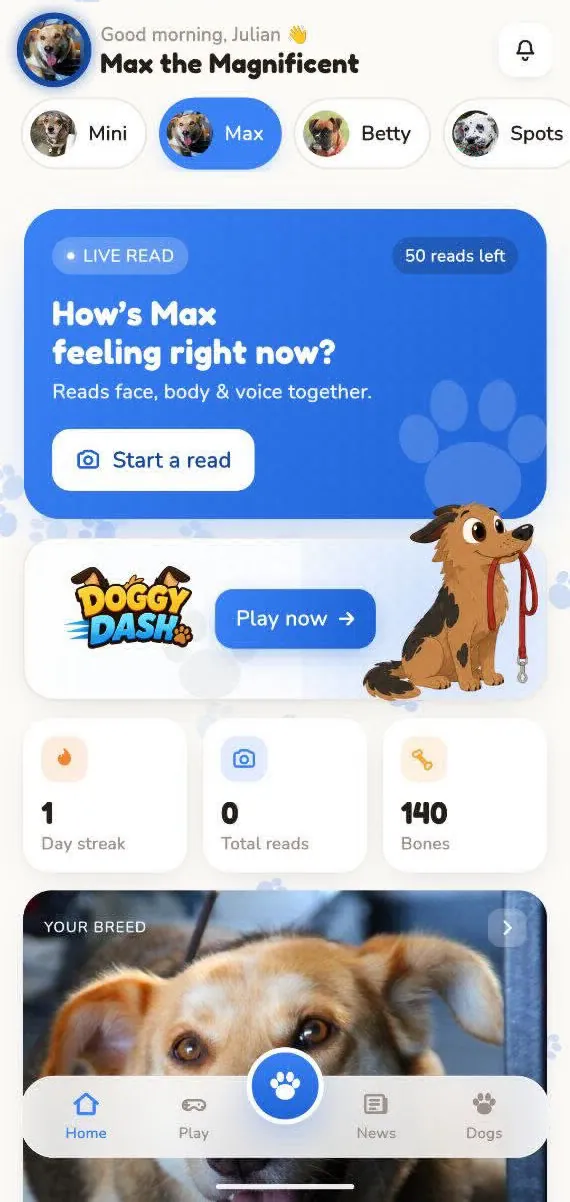
Max's home screen, one tap from a live read
Max's home base — one tap to a read

Story Mode

A monthly wrapped for your dog — a tap-through story built from the month you actually had together, with a mood forecast, the plot twists, and their Mood Type.

Written only from real reads — never invented.

The news feed, invites and monthly story entry point
Bark & bite news, quizzes and invites

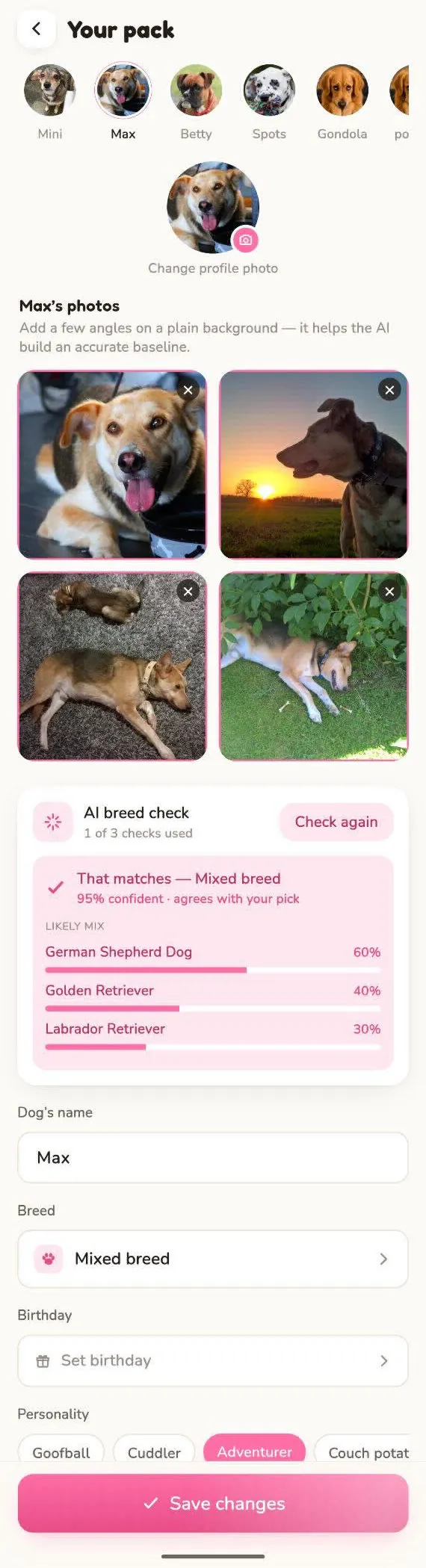
AI breed check

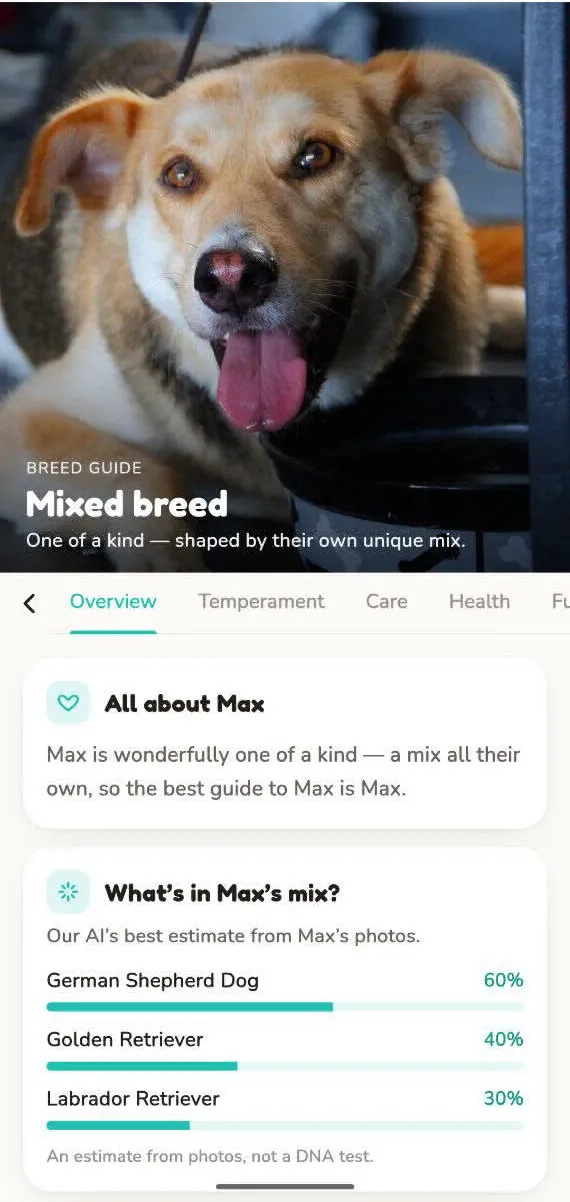
One photo returns the most likely breed and, for a mix, the breakdown — 60% German Shepherd, 40% Golden Retriever — with a confidence figure attached to each.

An estimate from photos — never presented as a DNA test.

Max's profile with photos and the AI breed check showing a mixed-breed breakdown
The full profile — photos, breed check, personality

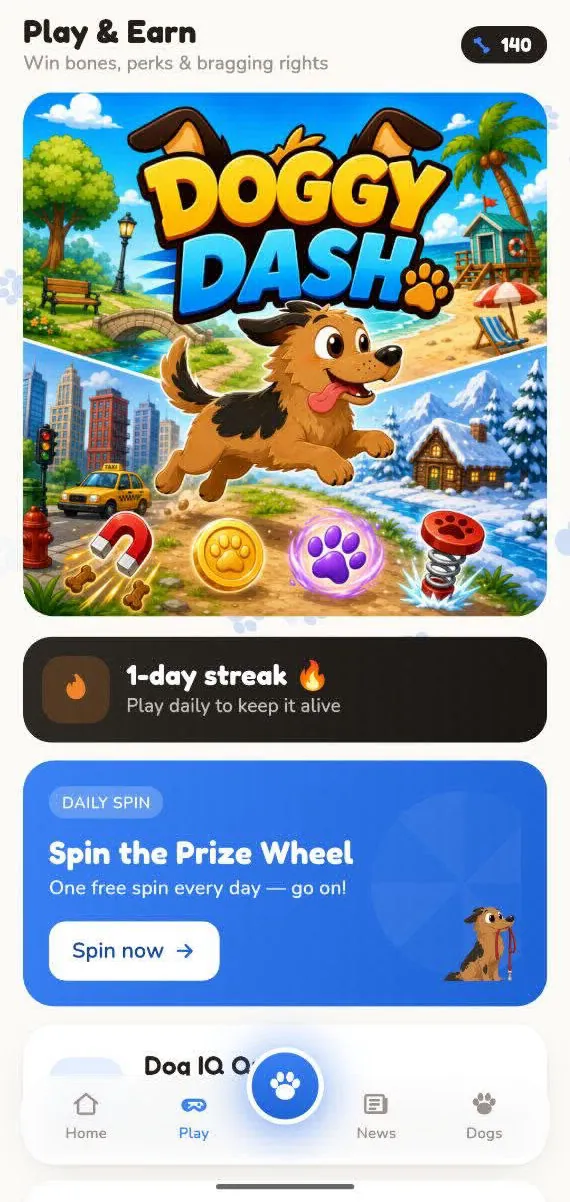
Play & earn

Doggy Dash is a real endless runner starring Rex across four worlds, and it pays in bones — as do streaks, the daily prize wheel and a 189-question Dog-IQ quiz.

Play and Earn, with Doggy Dash, the streak counter and the daily prize wheel
Play & earn — Dash, streaks, the daily wheel

Everything inside

The rest of it

Six moods, properly defined

Playful, Engaged, Uncertain, Puzzled, Startled and Appeasing — each with a written behavioural definition behind it, not just a label and a guess.

More detail +

"Appeasing" is a response to your tone, not guilt — dogs don't experience guilt, and the app says so rather than flattering you.

Every read names the observable cues that led to it, so you can check the verdict against the dog in front of you.

Behavioural definitions — never horoscopes.

Ask Rex

Say "Max just had 60g of gravy bones and we did a 40-minute walk" and it logs the meal with calories and the walk with minutes, then answers questions from the dog's real records.

More detail +

Around twenty-five real tool functions, not a chat wrapper.

Distils durable memories you can inspect and delete individually in Settings.

Rex checks before saving, only ever uses your own dog's records — and never plays vet.

Health Hub

Weight curve, medications, vaccination reminders backed by real OS notifications, and symptom notes — with a one-tap vet-visit summary generated entirely on your phone.

More detail +

The median UK first-opinion consult is under ten minutes. The handover is ready before you've taken your coat off.

Your journal, beautifully compiled — never veterinary advice.

Body & bowl

Scan a barcode and the food is logged. Energy targets come back as ranges built from your dog's actual weight, and for a growing puppy the app gives you the range rather than inventing a number.

More detail +

Barcode scan first, then a shared food catalogue, then a live open-data lookup, then a label scan as the fallback.

Ranges grounded in published guidance — never a made-up calorie count.

94 breeds, properly credited

A breed guide personalised to your dog's name, age and energy — temperament, care, health and the fun bits — with a real credited photo for every one.

One pack, the whole family

Dogs don't belong to one phone. Share dogs, reads, keepsakes and the health journal across the household, while everyone keeps their own account, theme and scores.

Invite codes are single-use and expire in 24 hours — and the whole household is told the moment anyone joins.

Adopt & buy safely

The four national UK rescue charities with their charity numbers, deep-linked straight to their own rehoming searches, plus plain-English guidance on the law.

Linked to the charities' own searches — never scraped, never rehosted.

Doggy Dash

A full endless-runner mini-game starring Rex — four worlds, three lanes, and a pocketful of chaos. Built into the app, free to play.

Architecture

How it's put together

A Flutter client of roughly 67,500 lines over 108 files, a small TypeScript Cloud Functions surface holding anything that must not be client-authoritative, and deny-by-default security rules.

App

Flutter, Android first
Flutter / Dart
app/lib/src — app, data, screens, services, state, theme, widgets
CameraX
Clip capture, with an on-device regression suite that exercises the real camera
On-device PDF
Vet-visit summaries generated locally, never server-side

Backend

~1,940 lines of TypeScript
Cloud Functions
Rewards, entitlements, household membership, invite codes
Gemini
The multimodal read, breed check, label scan and Story Mode prose
App Check
Play Integrity on Play installs; debug provider for local builds

Data

Firestore
Deny-by-default rules; grow-only maps for counters
Cloud Storage
Keepsake stills only — clips are never uploaded
Point-in-time recovery
Enabled after a merge-write once erased quiz stats

Third party

Open Pet Food Facts
Live nutrition lookup after the communal catalogue
Play Install Referrer
Referral auto-claim via an in-house method channel

Background

The story

Dogoos began with a question that turned out to have a real answer. Plenty of apps promise to translate a bark into a sentence; none of them can, and the ones that pretend otherwise are guessing on your behalf. But asking what state a dog is in — and being able to point at the ears, the weight distribution, the pitch of the whine that led you there — is a question ethology has spent decades on.

So the app was built around reading the whole dog. Face, body and voice go in together, because a tail on its own will mislead you and the research is unambiguous that combining signals is what makes these systems accurate. Six states, each with a written behavioural definition behind it. Real confidence, real per-signal scores, and the cues named so you can check the verdict yourself.

The part that took the longest was teaching it to stop. It is easy to build something that always has an answer, and that is exactly what makes most of this category untrustworthy. Dogoos would rather show you a card that says it couldn't see your dog clearly than hand you a mood it doesn't believe.

Around that core grew the rest of it — a monthly story built only from reads that actually happened, an assistant that logs a meal and a walk from one spoken sentence, a vet handover ready before you've taken your coat off, a household so a dog isn't trapped on one phone, and an endless runner starring a dog called Rex, because a dog app should be fun as well as careful.

Next

QR Protector

Check the code before you trust it